What Compliant Cleaning Looks Like Across Healthcare Settings

Posted by platform81 on October 12, 2026

What Compliant Cleaning Looks Like Across Healthcare Settings

Healthcare is not a single environment, and the compliance that governs cleaning within it is not a single rule. A hospital ward, a care home, a GP surgery and a dental practice all sit under different combinations of standards and regulators, yet each is measured against the same underlying purpose.

Knowing where those expectations align and where they diverge is what separates a provider that genuinely meets the brief from one that simply turns up.

Across Greater Manchester we work with providers in most of these settings, and the same question comes up in each of them, what does compliant actually mean here.

The Common Thread Across Every Setting

Whatever the building, cleaning in a healthcare environment exists to support infection prevention and control, and that purpose is the constant. Since 2021 there has also been a shared measurement framework in the form of the National Standards of Healthcare Cleanliness, which apply across all healthcare settings rather than the NHS alone.

What still changes from one setting to the next is the level of risk, the body holding providers to account and the specific overlay of rules that applies. Once that is clear, the variation between a hospital and a dental practice stops looking like inconsistency and starts looking like proportionality.


NHS Hospitals & Acute Trusts

In NHS settings the National Standards of Healthcare Cleanliness 2021 are mandatory and enforced. They replaced the 2007 national specifications and categorise every space by functional risk, so the highest risk clinical areas are held to the most demanding cleaning frequencies and audit scores.

Health Technical Memorandum guidance sits alongside them for specialist areas. Most acute contracts are held by large national providers, which means that for many independent firms this sets the benchmark other settings are measured against rather than a day to day market.

Care And Nursing Homes

Care homes are registered with and inspected by the Care Quality Commission, which expects premises and equipment to be clean, safe and properly maintained. Inspectors look for evidence that infection control is managed rather than assumed, so cleaning schedules, records and staff competency all come under scrutiny, with the 2021 standards available as the framework against which performance can be measured.

This is one of the most active areas of demand for care and nursing home cleaning, and the quality of documentation often matters as much as the cleaning itself.

GP Surgeries And Primary Care

Primary care sits under the same CQC oversight, but the environment brings its own demands. Treatment rooms, shared waiting areas and clinical touchpoints each carry different risk levels within a single building.

Compliant cleaning here means recognising those differences and applying the right method and frequency to each, rather than treating the whole premises as one uniform space. It also means a provider who can evidence what was cleaned, when and to what standard, because in primary care the record is part of the result.

Dental Practices

Dental settings add their own decontamination requirements under HTM 01-05, which governs how instruments and clinical areas are managed.

Much of that falls to the practice team, but professional cleaning in a dental practice still has to meet a clinical standard across the wider environment and work alongside that decontamination rather than in isolation.

Private Clinics & Outpatient Settings

Private providers registered with the CQC are held to the same fundamental standards as their NHS counterparts, with the added weight of reputation in a competitive market.

For a paying patient, a visibly clean and demonstrably compliant environment is part of the service, not an extra, and the cleaning protocols a private healthcare provider follows need to reflect that.

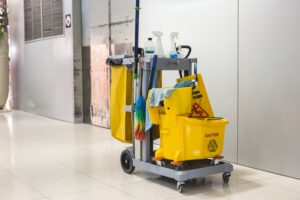
caution wet floor sign

What Compliant Cleaning Looks Like In Practice

Across all of these settings, the same practical markers define a compliant healthcare cleaning service. Colour coded equipment to prevent cross-contamination. Risk-based cleaning frequencies matched to each area. Auditable records that stand up to inspection. Trained staff who understand why a method matters, not only how to carry it out. Correct products used at the correct contact times. Recognised accreditation gives buyers independent evidence that these processes are managed to a defined standard, and it is one of the clearest signals to weigh when choosing a cleaning contractor.

Why Compliance Is Not Optional

For healthcare providers, cleaning is not a cosmetic concern. It feeds directly into inspection outcomes, patient and resident safety, and the contractual standing of the organisation. A poor cleaning record can show up in a CQC report, and a poor report follows an organisation into every future tender and referral. Getting it wrong carries consequences well beyond appearances, while getting it right is a measurable, evidenced part of running a safe service.

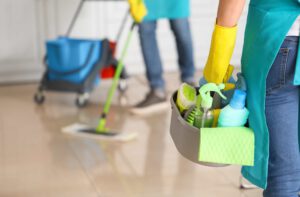
A close-up of a person wearing a white shirt and blue apron holding a blue bucket containing various cleaning supplies.

Talk To Us About Compliant Healthcare Cleaning

If you are responsible for cleaning standards in a care home, surgery or private clinic across Greater Manchester, we can help you evidence that your provision stands up to scrutiny. Call us on 0161 905 3000 or get in touch to arrange a no obligation cleaning survey.

1